

Dai Loy Gambling House Museum
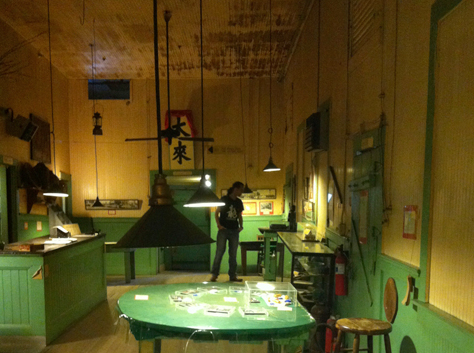
Built in 1915 by Bing Lee, this gambling hall was in continuous operation until 1950 when Sacramento County officials closed its doors. The name Dai Loy means “Big Welcome” in Chinese. It is now restored as a museum with displays of games and tables, Chinese artifacts, and archival photographs from the Delta.
A bench was placed outside for a watchman to sit, with a secret button hidden below to alert dealers inside of any approaching sheriff’s raids. Inside, located on the back wall, the rectangular window next to the big Dai Loy sign is a loft where a night watchman stayed to safeguard the building. It also allowed the watchman to overlook the gambling activities and prevent any cheating by the patrons.
The two openings on the ceiling are skywells (not skylights) designed primarily for ventilation and to remove smoke from patrons who smoked. The shape of the skywell creates an updraft and the high ceilings were designed to have a cooling effect by drawing away the summer heat. The artifacts on display have been covered for preservation.
All windows in the building were boarded up. All the doors were fortified with stronger and thicker wood to prevent and discourage robbers and raids.
Only men were allowed to gamble in the gambling hall, perhaps to avoid any domestic arguments inside. The gambling house was open to both Chinese and non-Chinese people.
Pai gow, fan tan, blackjack and high-low were popular games played in the gambling house. Chinese lottery tickets were sold both in-house and throughout the town by runners. Note the sign above the window with the list of times when numbers would be called.
The Chinese lottery tickets were played with 80 Chinese characters painted on the ping pong balls and the tickets. The balls were tumbled in a revolving wire basket cranked by hand. The first ten or twenty balls, depending on the game, which rolled out of the cage were matched to the winning tickets, whereupon big prizes could be won. The game was later westernized by replacing 80 characters with numbers 1 to 80, which opened it up to other ethnic groups to play. The game was later played in casinos in different states with a new name, Keno.
Pai Gow is an ancient Chinese gambling game played with 32 domino-like tiles, where players form two hands, a high hand and a low hand, to beat the dealer’s hand.
Fan-tan is a game of pure chance. The game is played by placing two handfuls of small objects on a board. In Dai Loy, it is played with buttons. The game is to guess the remaining count of the buttons when divided by four. After players have cast bets on values of 1 through 4, the dealer repeatedly removes four buttons from the board until only 1, 2, 3, or 4 buttons remain, determining the winner.
The Sacramento River Delta Historical Society volunteers worked together with Pin Lee, and the son of Lee Bing, to restore the gambling hall to its original form and open it to the public as a museum in April 1977. Most of the gaming tables and equipment were donated by Pin Lee. The building was sold to Clarence Chu in 1985.
Visitor Information:
Hours: Friday 11am to 4pm
Saturday, Sunday 11am to 4:30pm
Closed Monday-Thursday
Address: 13951 Main Street, Locke
Contact: 916.776.1684
Reservations: tours(at)locke-foundation.org